 blog
Singles vs. Booster Packs: Which Buying Strategy Wins
Table of Contents
- The Core Trade-Off: Singles vs. Booster Packs
- Understanding Booster Box Hit Rates and Expected Value
- Why Singles Win for Competitive Players and Budget Builders
- Best Places to Buy Rare Cards and Complete Sets
- Investing in Trading Cards: Sealed vs. Secondary Market
- Avoiding the Gambler's Fallacy in Pack Opening
- Condition, Grading, and Resale Value
- Frequently Asked Questions
Last Updated: September 25, 2026
The Core Trade-Off: Singles vs. Booster Packs
When you're building a trading card collection, you face a fundamental choice between singles vs booster packs: buy individual cards or open booster packs? The answer depends entirely on what you're trying to accomplish. Singles vs. booster packs represent two distinct strategies with different financial outcomes, risk profiles, and psychological rewards.
Buying individual cards gives you precision. You know exactly what you're getting. Competitive players need this certainty, they can't afford to spend money on cards they don't need. Budget builders also benefit because every dollar goes directly toward completing their target set.
Opening booster packs offers something different: the thrill of the unknown. You might pull a chase card worth three times your box cost, or you might not. This variance is what keeps many collectors coming back, even when the expected value doesn't support it mathematically.
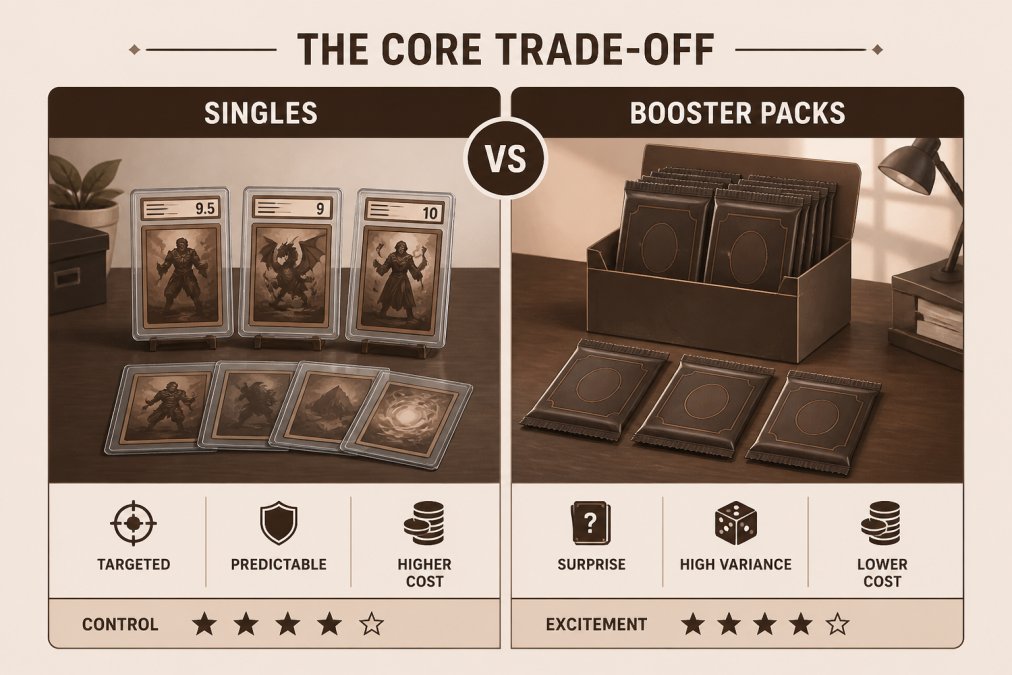
The reality is this: for most people, buying singles vs. booster packs isn't an either-or decision. You'll likely use both strategies at different times. The key is understanding when each approach makes sense for your specific goal.
Understanding Booster Box Hit Rates and Expected Value
What Pull Rates Actually Mean for Your Wallet
Pull rates show the probability of hitting specific rarity tiers, but they only become predictable across large sample sizes, not individual boxes. You might spend $100 on a booster box and pull $60 worth of cards at secondary market prices, or $150 worth. Most casual buyers ignore this variance, assuming they'll pull proportional value. This unpredictability is why sealed product appeals emotionally but often fails financially.
Calculating Expected Value: A Structured Framework
Expected value (EV) is the mathematical foundation for comparing singles to packs. Here's how to calculate it yourself rather than relying on anecdotal claims:
The Basic Formula: EV per pack = (Sum of all card values in set × Probability of pulling each) ÷ Number of packs in box
A Worked Example: Assume a 36-pack booster box with 4 chase cards worth $30 each (1 in 9 packs), 8 high-value rares worth $8 each (1 in 4.5 packs), and 20 mid-tier cards worth $2 each (1 in 1.8 packs). Theoretical EV per pack is ~$50, or ~$1,800 per box. If the box costs $100, this looks profitable, but this calculation ignores critical real-world factors:
Condition Adjustment: Most casual pulls are lightly played or moderately played, not near-mint. Reduce values by 30-50% for realistic condition, bringing adjusted EV per box to ~$900-$1,260.
Market Liquidity & Transaction Costs: Bulk commons often don't sell. Listing fees (10-15%) and shipping ($3-$5) reduce net proceeds another 15-20%.
Practical EV: Most modern booster boxes deliver 60-75% of their purchase price in actual resale value. A $100 box yields $60-$75 in realistic proceeds. This gap exists because retailers need margin and set rotation causes older cards to lose value. Opening packs isn't always wrong, some people value the entertainment more than the money. Just know what you're actually paying for.
Build Your Own EV Calculator: List all cards in the set with current secondary market prices, research pull rates, adjust prices down 40% for realistic condition, subtract 15% for fees and shipping, divide by pack count, and multiply by 36. If the result is below the box price, singles are mathematically superior.
Why Singles Win for Competitive Players and Budget Builders
Competitive players need specific cards in near-mint condition, when comparing singles vs booster packs, opening booster boxes hoping to pull them is inefficient. Singles vs. booster packs becomes obvious: buy singles for the exact card, condition, and quantity you need. Budget builders face the same logic: $50 spent on four or five specific cards guarantees progress toward set completion, while a booster box offers only a small chance at a big win.
Best Places to Buy Rare Cards and Complete Sets
Find vendors who verify authenticity, clearly state card condition, and handle shipping carefully. Condition grading matters enormously, a "near-mint" card might grade PSA 8 or PSA 9, while "lightly played" could be PSA 6 or PSA 7, with substantial price differences. Dave's House of Cards offers a curated selection of individual cards from popular series with straightforward ordering and free USPS Ground Advantage Shipping over $25.
Investing in Trading Cards: Sealed vs. Secondary Market
Factory Sealed Product as an Investment
Some collectors view sealed booster boxes as investments. The theory is simple: as a set rotates out of print, sealed product becomes scarcer and more valuable. A $100 box today might be worth $200 in five years.
Long-Term Storage and Preservation for Value
Whether you're holding sealed boxes or individual cards, storage conditions determine long-term value. Temperature fluctuations, humidity, and light exposure all degrade cards over time.
Avoiding the Gambler's Fallacy in Pack Opening
Gambler's fallacy is the belief that past results influence future probability. If you opened three packs without a chase card, you might think the next pack is "due." Mathematically, that's false, each pack has the same probability. But gambler's fallacy is only one of several cognitive biases that make pack opening financially irrational.
The Gambler's Fallacy: "I'm Due"
This fallacy costs collectors real money. They chase losses by opening more packs, convinced their luck is about to turn. It doesn't work that way. The pull probability doesn't change based on your recent history.
The Sunk Cost Fallacy: "I've Already Spent This Much"
Sunk cost fallacy is more dangerous than gambler's fallacy because it feels logical. You've already spent $200 on booster boxes without hitting your target card. You think: "I'm already $200 in, might as well spend another $100 to finish the set."
The Dopamine Loop: Why Opening Feels Good
Pack opening triggers a dopamine response in your brain. The anticipation of opening a pack, the physical act of revealing cards, and the possibility of a big hit all activate reward pathways. This is not a character flaw, it's neurobiology.
The Illusion of Control: "I Have a System"
Many collectors develop rituals or strategies they believe improve their pull rates: opening packs in a specific order, opening at specific times, or using "lucky" sleeves. None of these affect probability, but they create a false sense of control.
The Availability Heuristic: "I Saw Someone Pull That"
You see a social media post of someone pulling a $200 chase card from a booster pack. Your brain overweights this example because it's vivid and memorable. You think: "That could be me." This is availability heuristic, judging probability based on how easily examples come to mind.
Recognizing the Bias Cluster
These biases often work together. You experience a sunk cost (already spent $200), which triggers availability heuristic (you remember the one person who pulled big), which triggers the illusion of control (you develop a ritual), which triggers gambler's fallacy (you think you're due). Before you know it, you've spent $500 chasing a negative EV.
Condition, Grading, and Resale Value
Card condition directly affects resale value, a near-mint copy might sell for $20 while a lightly played copy sells for $10. Professional grading adds credibility but costs $10-$15, which only makes sense for valuable cards. Understand condition grades before buying: "near-mint" means fresh from a pack, "lightly played" means visible handling but no creases, "moderately played" shows clear wear. Most casual collectors underestimate condition's impact on value.
Frequently Asked Questions
Is it more cost-effective to buy individual cards or booster packs?
Individual cards are typically more cost-effective if you need specific cards for a deck or set. You pay only for what you want, avoiding the variance of pack pulls. Booster packs appeal to collectors seeking the thrill of discovery, but the expected value per card is usually lower. Your cost per card depends on your goal: competitive play favors singles, while casual collecting may justify the pack-opening experience.
What do booster box hit rates tell me about expected value?
Hit rates show how frequently you'll pull chase cards or high-value cards from a box. Modern sets typically have documented pull probabilities for rare and mythic cards. Understanding these rates helps you calculate whether the cost of a sealed booster box aligns with the likely value of cards you'll pull. High pull rates don't guarantee profit; they simply show the frequency of valuable pulls, which you can compare against the box's market price.
Should I buy sealed booster boxes if I'm investing in trading cards?
Factory sealed booster boxes can hold or gain value over time, especially for older or out-of-print sets, because supply is fixed and demand may grow. However, sealed product requires proper long-term storage and preservation to maintain condition and value. Individual chase cards from those sets may appreciate faster if graded highly. Your investment strategy should match your timeline and storage capacity; sealed boxes suit long-term holders, while individual cards offer more liquidity.
What is the Gambler's Fallacy in trading card pack opening?
The Gambler's Fallacy is the belief that past pulls influence future ones. If you open five packs without a chase card, you might think the next pack is 'due' for one. In reality, each pack's pull probability is independent; previous results don't change your odds. This fallacy often leads collectors to spend more than intended chasing a hit. Understanding that variance is normal helps you set a budget and stick to it, whether buying packs or singles.