 blog
Best Protective Sleeves for Cards: 2026 Guide
Table of Contents
- Quick Comparison: Top Sleeve Types and Materials
- Types of Protective Sleeves for Cards: Soft, Hard, and Everything Between
- Perfect Fit vs Standard Sleeves: What's the Difference?
- Top Loaders vs Card Sleeves: Which Offers Better Protection?
- How to Store Trading Cards Properly for Long-Term Protection
- How to Choose the Right Sleeve for Your Collection
- Frequently Asked Questions
Last Updated: September 23, 2026
Quick Comparison: Top Sleeve Types and Materials
The best protective sleeves for cards balance fit, material, and rigidity against how you actually use the card. A soft penny sleeve handles everyday play, while a rigid holder protects a card you never intend to shuffle again.
This guide from Dave's House of Cards breaks down every sleeve type, material, and fit so you can match the right protection to the right card. Here's the short version before the details:
| Sleeve Type | Material | Rigidity | Best For |
|---|---|---|---|
| Penny sleeve | Clear polypropylene | Soft | Bulk storage, inner layer |
| Standard sleeve | Polypropylene | Soft | Playable decks, shuffling |
| Perfect fit | Polypropylene | Soft | Double-sleeving, inner layer |
| Matte sleeve | Textured polypropylene | Soft | Tournament play, less glare |
| Toploader | Rigid PVC | Hard | High-value singles, shipping |
| Card saver | Semi-rigid plastic | Semi-rigid | Grading submissions |
Materials matter more than most buyers realize. Acid-free, archival-safe plastics resist the chemical breakdown that yellows cards over decades, while cheap PVC can leach plasticizers onto the surface. That single distinction separates storage that protects from storage that quietly damages.
Types of Protective Sleeves for Cards: Soft, Hard, and Everything Between
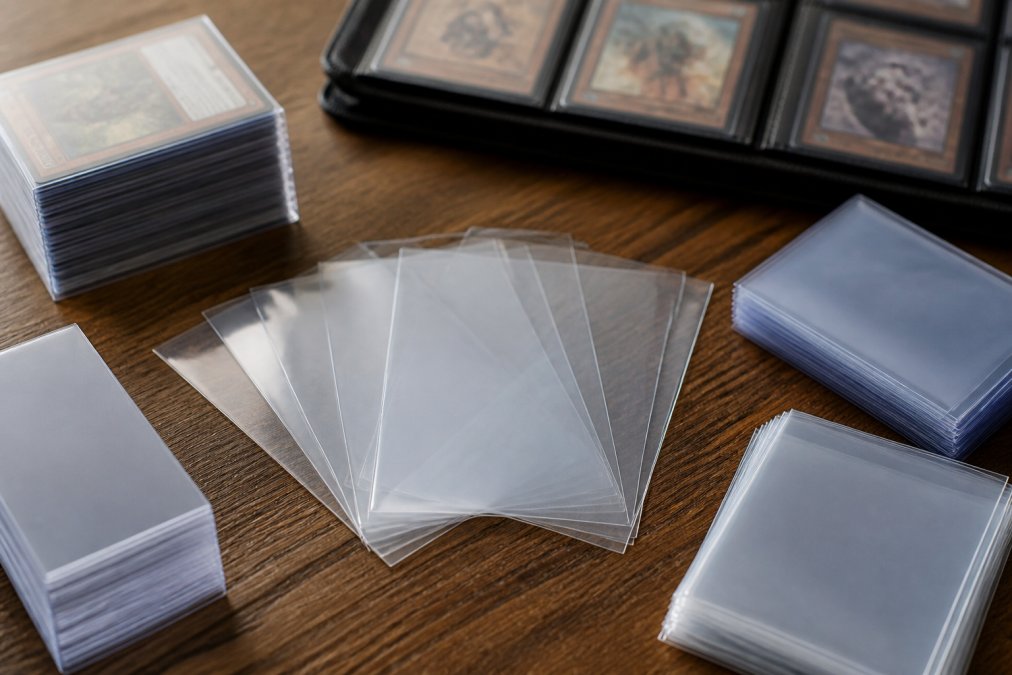
Protective sleeves fall into two families: soft sleeves that flex with the card and rigid holders that lock it flat. Soft sleeves include penny sleeves, standard sleeves, and perfect fit inner sleeves. Rigid options include toploaders and semi-rigid card savers.
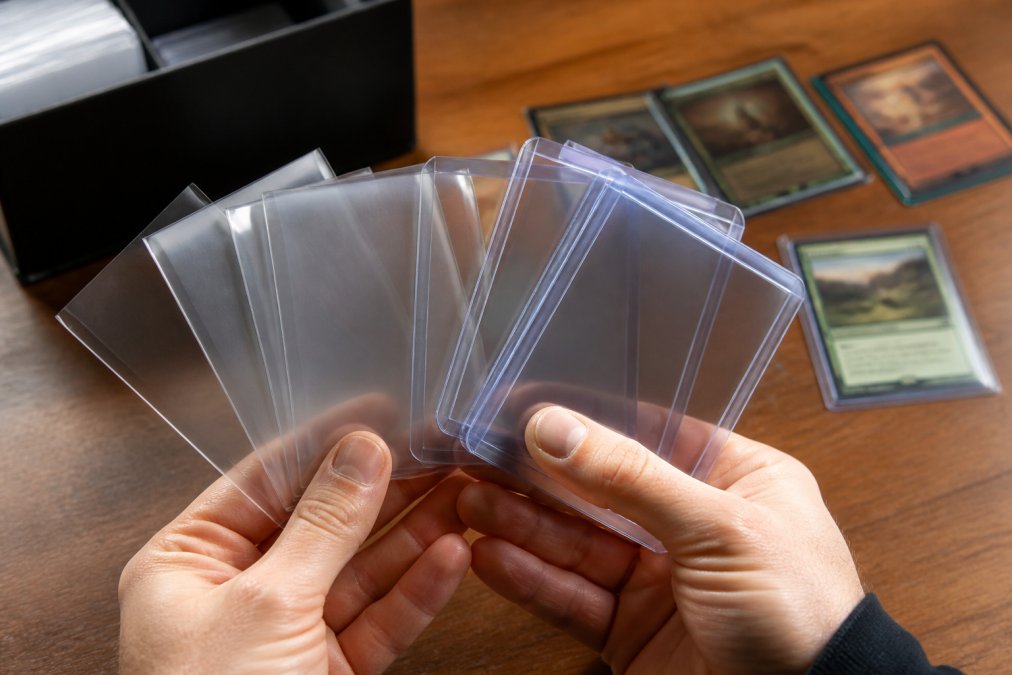
Soft sleeves protect against scratches, dust, and handling oils. They're thin, flexible, and cheap enough to sleeve an entire collection. The trade-off is rigidity: a soft sleeve won't stop a card from bending.
Rigid holders solve that. A toploader is a stiff plastic shell, usually measured at 35pt thickness, that keeps a card perfectly flat.
Perfect Fit vs Standard Sleeves: What's the Difference?
Perfect fit sleeves hug the card with almost no slack, while standard sleeves leave a small border of extra plastic around the edges. The difference comes down to millimeters, and it decides whether a card slides or stays put.
When to Use Each Type
- Perfect fit: inner layer for double-sleeving, grading prep, and any card where a snug seal matters
- Standard: playable decks, casual storage, and anything you'll shuffle repeatedly
- Perfect fit inside standard: the classic double-sleeve combo for competitive decks and valuable playables
- Standard alone: bulk commons and cards you handle often but don't consider high-value
Double-sleeving is the technique competitive players rely on: a perfect fit inner sleeve plus a standard outer sleeve. The inner layer blocks dust and moisture from the card face; the outer layer absorbs shuffle wear. The thing nobody tells you about double-sleeving is that it thickens the deck noticeably, so check whether your deck box still closes before you commit.
Shuffle Feel: Matte vs. Gloss and Why It Decides Your Sleeve
Shuffle feel is the most under-discussed spec in sleeve buying, and for anyone who plays weekly it matters more than thickness. The surface finish on the outer sleeve controls how the deck moves in your hands, and the two options behave very differently.
A practical pattern competitive players follow:
- Casual play and storage: gloss is fine and usually cheaper
- Weekly tournament play: matte outer sleeves, because the friction and glare reduction pay off over hundreds of shuffles
- Double-sleeving: a perfect fit inner plus a matte outer is the common competitive setup; the inner keeps the card clean and the matte outer handles the shuffle
- Grading prep: skip matte entirely; use a perfect fit and a rigid holder, because shuffle feel is irrelevant for a card that never gets shuffled
Top Loaders vs Card Sleeves: Which Offers Better Protection?
Top loaders win on rigidity, and card sleeves win on playability. For a card you're storing or shipping, a toploader offers more protection. For a card you're playing, a sleeve is the only practical choice.
| Factor | Top Loader | Card Sleeve |
|---|---|---|
| Rigidity | Rigid, bend-resistant | Soft, flexible |
| Shuffleable | No | Yes |
| Best use | Storage, shipping | Play, handling |
| Bulk | High | Low |
How to Store Trading Cards Properly for Long-Term Protection
Proper storage means controlling three things: light, moisture, and physical pressure. Get those right and a collection can hold its condition for decades. Get them wrong and even sleeved cards will fade, warp, or stick together.
- Sleeve every card before it touches a box or binder
- Use rigid holders for anything above bulk value
- Store cards upright, not stacked under heavy weight
- Keep collections out of damp basements and hot attics
- Avoid direct sunlight, which fades ink over time
UV Protection and Climate Control
UV light is the quiet killer of card condition. It breaks down the inks and coatings that give a card its color and gloss, and the fading is permanent. Sleeves and holders labeled UV-resistant slow that process, but no sleeve fully blocks light.
How to Choose the Right Sleeve for Your Collection
Choosing a sleeve comes down to three questions: how you use the card, how valuable it is, and how long you plan to keep it. Answer those and the right sleeve type picks itself.
Use this decision framework:
- Playing it in a deck? Standard or matte sleeve, double-sleeved if it's valuable
- Storing a high-value single? Perfect fit inner sleeve plus a toploader
- Submitting for grading? Card savers, which are shaped for grading shipments
- Bulk storage? Penny sleeves and a storage box
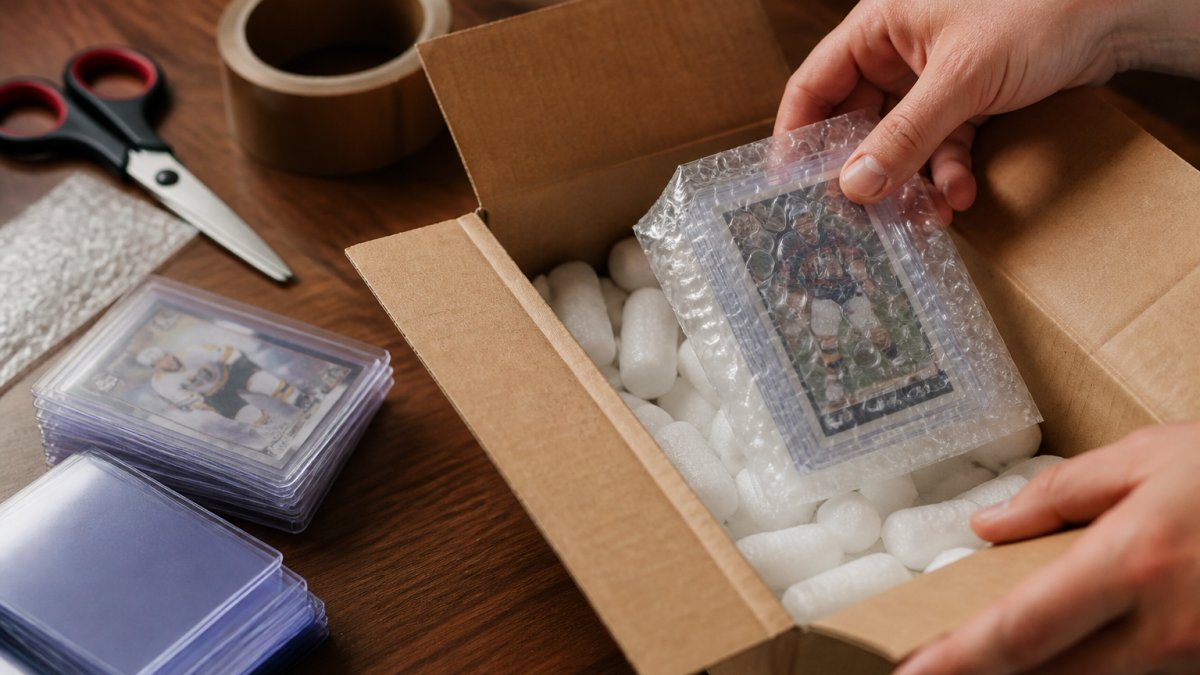
- Shipping a sale? Sleeve, then toploader, then a rigid mailer
Card Size Compatibility Matrix
Fitment is the detail most buyers skip, and it's the single most common cause of a sleeve that scuffs a card or won't seat in a deck box. Trading cards are not one size. The two dominant dimensions are standard size (2.5 by 3.5 inches, 63 by 88 mm) and Japanese size (2.48 by 3.46 inches, 63 by 88 mm nominal but cut slightly smaller in practice, often listed as 59 by 86 mm).
| Card Game | Card Size | Sleeve Size to Buy | Notes |
|---|---|---|---|
| Magic: The Gathering | Standard (2.5 x 3.5 in) | Standard | Most common size; fits the widest range of sleeves |
| Pokémon TCG | Standard (2.5 x 3.5 in) | Standard | Same footprint as MTG; Japanese-printed cards can run slightly smaller |
| Yu-Gi-Oh! | Japanese (approx. 2.32 x 3.38 in) | Japanese / small | Standard sleeves leave visible slack and let the card shift |
| Digimon Card Game | Standard (2.5 x 3.5 in) | Standard | Uses the standard footprint |
| One Piece Card Game | Standard (2.5 x 3.5 in) | Standard | Standard footprint |
| Flesh and Blood | Standard (2.5 x 3.5 in) | Standard | Standard footprint |
| Sports cards (Topps, Panini) | Standard (2.5 x 3.5 in) | Standard | Vintage cards can run slightly off-spec; measure before buying |
Acid-Free and Archival-Safe: What the Labels Actually Mean
Acid-free and archival-safe labels aren't marketing fluff. They describe plastics that won't off-gas or leach chemicals onto your cards over years of storage. Polypropylene and polyethylene are the safe base materials; PVC is the one to avoid for long-term storage because its plasticizers can migrate onto card surfaces and cause sticking or discoloration. For a collection you plan to keep, that's the single most important spec on the package.
Frequently Asked Questions
What sleeves does PSA recommend for card grading?
PSA recommends submitting cards in standard-sized soft sleeves (penny sleeves) placed inside rigid toploaders or Card Saver I holders. The key is to use acid-free, archival-safe materials that won't damage the card during transit. Avoid thick rigid holders that may shift during shipping. Always use a fresh sleeve and ensure the card is centered before sealing.
Are penny sleeves enough to protect valuable cards?
Penny sleeves offer basic protection against scratches, dust, and handling, but they don't provide rigidity or UV protection. For valuable cards, use penny sleeves as inner sleeves and place them inside toploaders or rigid holders. This double-sleeving approach protects corners and prevents bending. For long-term storage, add a UV-resistant box and keep cards in a cool, dry place.
How to sleeve cards without damaging the corners?
Hold the card by its edges and gently slide it into the sleeve at a slight angle to avoid catching corners. Use a sleeve that matches your card's size (standard 2.5 x 3.5 inches or Japanese 2.3 x 3.4 inches). Avoid forcing the card. If using perfect fit sleeves, insert the card slowly and check that no corners bend. For extra safety, use a card saver or toploader as an outer layer.
What is the best way to protect trading cards from UV damage?
UV damage fades ink and yellows card stock. Use sleeves and toploaders with UV-resistant additives, and store cards in a dark, cool place away from direct sunlight. Acid-free, archival-safe materials prevent chemical degradation. For high-value cards, consider professional grading and encapsulation. Avoid PVC sleeves, which can off-gas and damage cards over time.
Protecting a collection is a long game, and the sleeves you choose today decide what your cards look like in ten years. Dave's House of Cards makes it easy to find the individual cards you need, with authentic cards, convenient online shopping, and free shipping thresholds that reward building your set in one order. Shop all at Dave's House of Cards and give every card the protection it deserves.