 how-to
How to Spot Fake Trading Cards: 2026 Collector's Guide
Table of Contents
- Common Counterfeit Card Signs You Can Spot in Seconds
- How to Use a Jeweler's Loupe for Cards: Print Quality and Dot Patterns
- Light Transmission, Black Light, and UV Tests for Fake Trading Cards
- Texture, Card Stock, and the Bend Test: Physical Comparison
- Identifying Artificial Aging and Reprint Red Flags
- Buying Rare Cards Safely Online: Verification and Grading Slabs
- Frequently Asked Questions
Last Updated: September 20, 2026
Common Counterfeit Card Signs You Can Spot in Seconds
Learning how to spot fake trading cards starts with one hard truth: most counterfeits give themselves away before you ever need a magnifying glass. Counterfeit cards usually fail on color accuracy, card stock, and print quality, and those flaws show up fast under normal light.
Here's what to check in the first ten seconds:
- Color accuracy: Real cards have rich, deep ink. Fakes look washed out or oversaturated.
- Card stock: Genuine cards have a slight flex. Counterfeits feel stiff or papery.
- Print quality: Edges on a fake look fuzzy, not sharp.
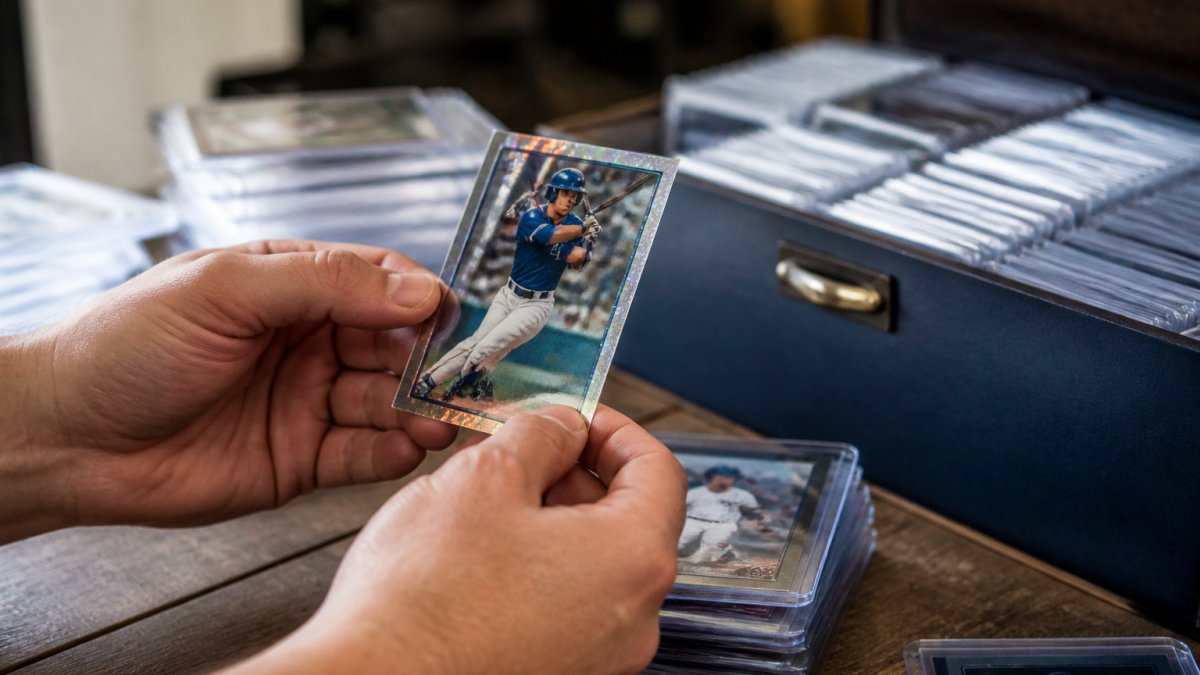
- Texture: Real cards have a subtle finish. Fakes feel slick or waxy.
How to Use a Jeweler's Loupe for Cards: Print Quality and Dot Patterns
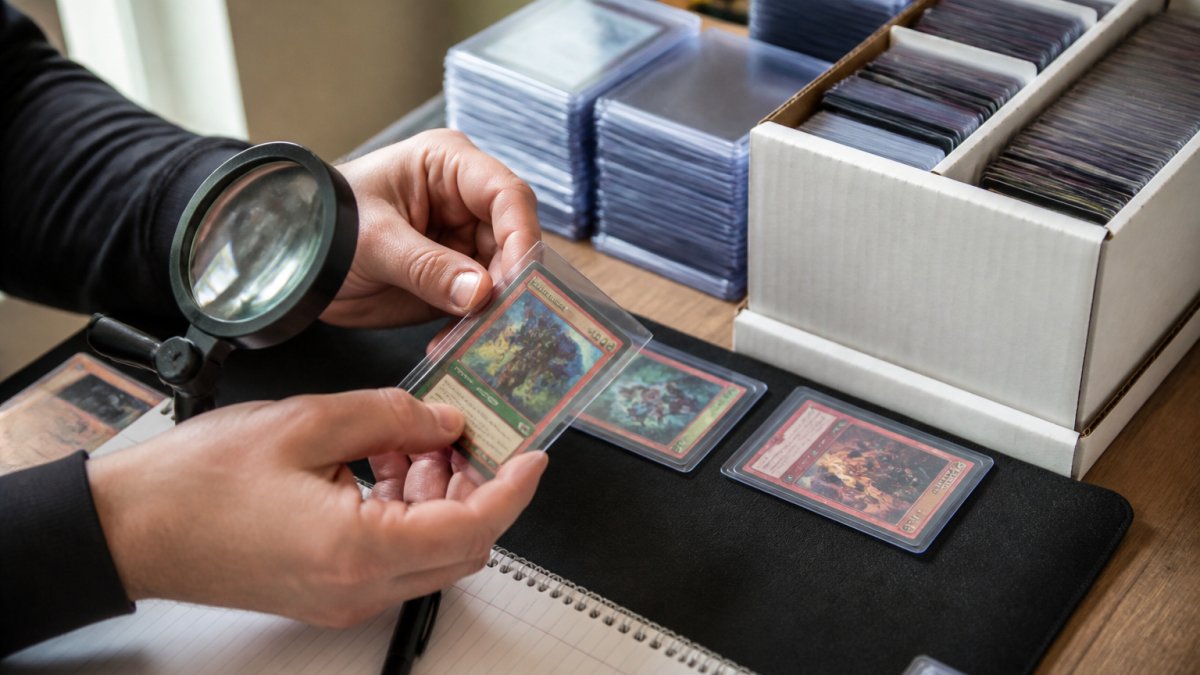
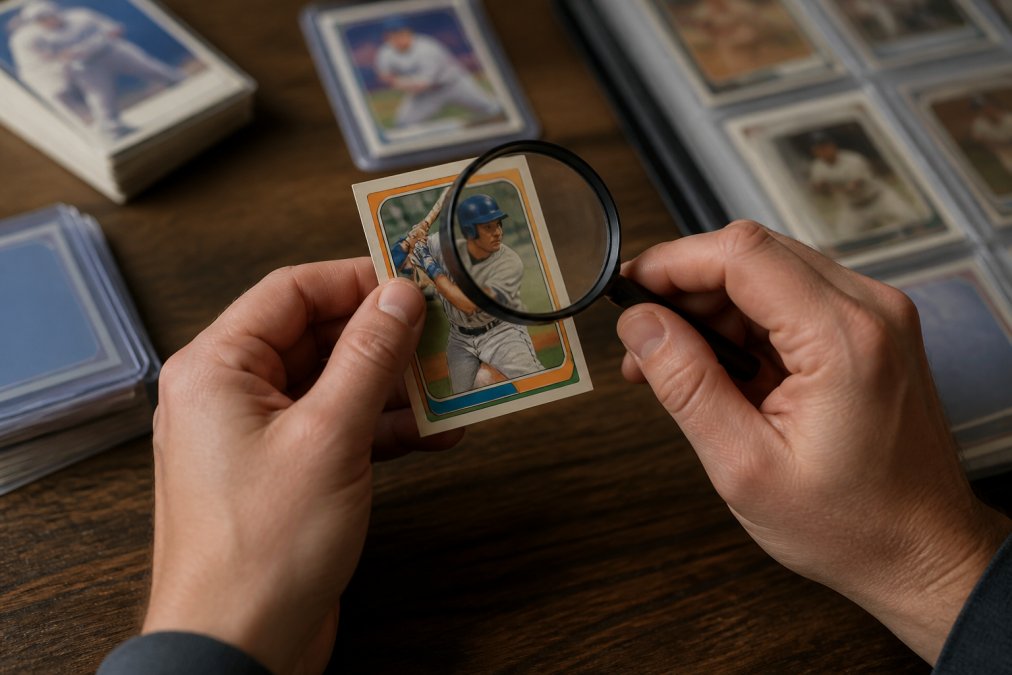
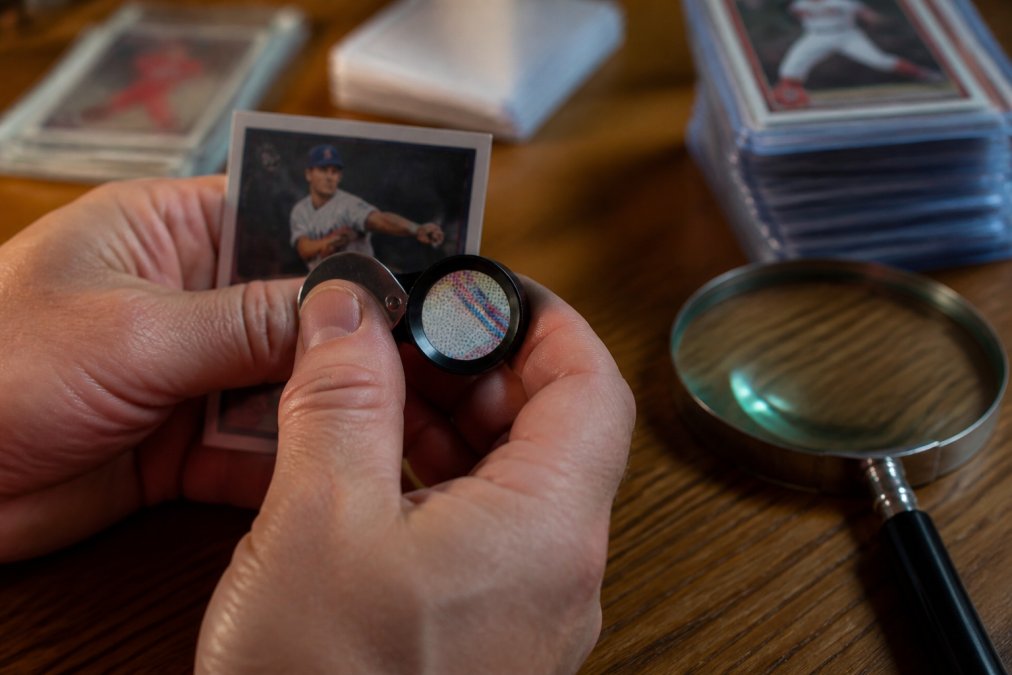
A jeweler's loupe is the single best tool for spotting fake trading cards, and it costs very little. A 10x or 20x loupe reveals the print pattern that commercial printers use. Counterfeiters rarely match it.
Reading the Rosette Pattern and Dot Matrix
Genuine trading cards are printed with a rosette pattern, a cluster of tiny colored dots arranged in a flower-like shape. This dot matrix comes from offset printing, and it's almost impossible to fake cleanly. The dots are laid down in overlapping screens of cyan, magenta, yellow, and black, and the rosette is the visible result of those screens intersecting at fixed angles.
Under magnification, look for:
- Crisp, separated dots in a repeating rosette shape on real cards
- Blurry or merged dots on counterfeits, often from inkjet or low-resolution printing
- Solid blocks of color where dots should be, a dead giveaway of a reprint
- A uniform dot grid with no rosette at all, which points to a digital press rather than offset
Where the Pattern Breaks Down First
Counterfeiters tend to copy the most visible art and let the rest slide. That means the pattern fails in predictable places:
- Card backs: Border lines, copyright text, and the set logo are often reprinted from a scan, so the dots smear together.
- Text boxes: Fine rules and small type lose their dot structure and print as solid or fuzzy lines.
- Energy and mana symbols: The interior shading of a symbol is hard to reproduce; fakes show flat color instead of a screened gradient.
- Foil and holo areas: Foil is stamped, not printed, so the dot pattern should stop at the foil edge. If dots continue across the foil, the card was printed as one flat image.
Adding a Digital Microscope to the Loupe
A loupe is enough to catch most fakes, but a USB or Wi-Fi digital microscope takes the guesswork out of the comparison. These scopes plug into a phone or laptop and capture still images at 50x to 200x, which lets you overlay a suspect card against a known genuine one from the same set. The practical workflow is simple: photograph the same spot on both cards at the same magnification, then compare dot size, spacing, and color registration side by side.
Light Transmission, Black Light, and UV Tests for Fake Trading Cards
Light is the fastest way to expose a fake, and you don't need expensive gear. Hold the card up to a bright lamp or window. Genuine card stock blocks most light evenly. A counterfeit often glows brighter in patches or shows a thin, uneven core.
Run these tests in order:
- Backlight test: Hold the card to a lamp. Look for uneven glow or a visible core line.
- Black light test: Shine a UV light across the surface. Check for even reaction.
- Holographic foil check: Real foil shifts color as you tilt it. Fake foil looks static or dull.
Texture, Card Stock, and the Bend Test: Physical Comparison
Texture and card stock separate real cards from reprints more reliably than any single visual check. Genuine cards use layered stock with a specific grain. Run your fingertip across the surface. Real cards feel slightly textured. Fakes feel too smooth or too rough.
Weight, Thickness, and Centering Checks
A digital scale and a caliper give you hard numbers. Genuine cards fall within a tight range for card thickness and weight, while counterfeits often run thin or heavy.
| Check | Real Card | Counterfeit Card |
|---|---|---|
| Surface texture | Subtle grain | Slick or waxy |
| Bend test | Springs back | Creases or stays bent |
| Thickness | Consistent | Thin or uneven |
| Centering | Even borders | Shifted image |
| Gloss finish | Even sheen | Patchy or too shiny |
Identifying Artificial Aging and Reprint Red Flags
Artificial wear is one of the sneakiest tricks in the hobby. Sellers scuff edges, yellow the surface, and soften corners to make a modern reprint look like a vintage card. The wear is usually too even, or it sits in the wrong places.
Look for these reprint red flags:
- Font alignment that's slightly off, with letters spaced unevenly
- Micro-print that's blurry or missing on fine text
- Ink saturation that's too heavy or too light in one area
- Wear on the face but a perfectly clean back, or the reverse
Buying Rare Cards Safely Online: Verification and Grading Slabs
Buying rare cards safely online comes down to two things: verifying the seller and verifying the card. Photos alone are not enough, since a seller can use high-resolution images of a real card and ship a proxy. The shift from spotting fakes to preventing them starts before you pay.
Reading Listing Photos for Red Flags
Most counterfeit listings fail on the photos before the card ever arrives. Watch for:
- Stock photos or manufacturer images instead of photos of the actual card in hand
- Blurry or cropped shots that hide the card back, corners, or serial number
- The same photo reused across multiple listings or sellers
- No scale reference, which makes it hard to judge thickness or centering
- Lighting that washes out texture, hiding a slick or waxy finish
Ask for these before you buy:
- Clear close-up photos of the card back and the print pattern
- A photo of the card under UV or black light
- The serial number and any grading details
- A short video tilting the card, so you can see whether foil shifts
Verifying a Grading Slab by Serial Number
Grading slab fraud is a growing problem. Fake slabs copy the look of a professional grading service, but the label or the case gives it away. The verification step is the same regardless of which service graded the card:
- Find the certification number on the label. It is usually printed near the barcode or under the grade.
- Go to the grading service's official website and use its public certification lookup.
- Confirm that the returned record matches the card in front of you: the set, the card number, the grade, and the year.
- Check that the label's fonts, spacing, and holographic seal match the service's current design. Counterfeiters often reuse an older label template.
- Inspect the case itself. Genuine slabs have consistent sonic welds, clean edges, and a label that sits flat with no bubbling or misalignment.
Digital Verification Tools Worth Using
Manual inspection still leads, but a few digital tools speed up the process:
- Grading service lookup apps and websites for instant serial-number checks
- Digital microscopes for capturing and comparing dot patterns against a saved reference
- Reverse image search on listing photos to catch reused or stock images
- Community databases and set checklists to confirm that a card number, rarity, and print run actually exist for that set
A few habits keep you safe:
- Buy from sellers with a real return policy and clear condition notes
- Pay with a method that offers buyer protection
- Ask questions before you commit, and treat vague answers as a warning
- Run every slab serial number before you bid or buy
Frequently Asked Questions
What are the most common signs of fake trading cards?
The most common signs include blurry or pixelated print, missing dot matrix or rosette patterns under magnification, incorrect font alignment, off-center borders, flimsy card stock, and a lack of holographic foil shimmer. Fake trading cards often feel thinner and lack the gloss finish of authentic cards. A quick loupe check on the card back energy symbol and a black light test for UV fluorescence will catch most counterfeits before you buy.
Can professional grading services like PSA detect fake cards?
Yes. Grading services use high-resolution magnification, UV light, and database cross-referencing to verify authenticity before encapsulating a card in a grading slab. They examine print quality, dot matrix patterns, card stock, and serial numbers. If a card fails authentication, it is returned without a grade. Always verify the slab's serial number directly on the grading company's website to confirm it matches the card inside.
What should I do if I suspect I purchased a fake card?
First, stop any further transactions with that seller. Document the card with high-resolution photos, including close-ups of the print pattern, edges, and any holographic foil. Use a jeweler's loupe to capture the dot matrix and compare it to a known authentic copy. Then contact the seller or marketplace for a refund. If you paid by credit card, you may file a dispute. Report the seller to the platform and consider submitting the card to a grading service for official verification.
Are there specific light tests to identify counterfeit cards?
Yes. Hold the card under a black light or UV flashlight. Authentic cards typically do not glow brightly because their card stock lacks optical brighteners, while many counterfeits fluoresce blue-white. You can also hold the card up to a strong light source to check for light transmission: authentic cards block most light, while thinner fakes allow more through. Compare results against a known authentic card from the same set for the most reliable read.