 how-to
Buying Rare Cards for Investment Portfolios: 2026 Guide
Table of Contents
- Why Rare Cards Belong in a Serious Investment Portfolio
- TCG Investing for Beginners: Start With a Plan, Not a Purchase
- How to Evaluate Trading Card Value Using Recent Sales
- Trading Card Grading and Investment: Condition Is the Price
- Trading Card Portfolio Diversification and Risk Management
- The Due-Diligence Checklist Before You Buy Rare Cards
- Fees, Taxes, Liquidity, and Your Real Net Return
- Conclusion
- Frequently Asked Questions
Last Updated: October 17, 2026
Why Rare Cards Belong in a Serious Investment Portfolio
Rare cards are collectible assets with limited supply, and that scarcity makes them worth considering as an alternative investment. This guide from Dave's House of Cards walks through buying rare cards for investment portfolios, from valuation to exit.
Most guides treat card investing like a lottery ticket instead of a disciplined purchase. You wouldn't buy a stock without checking the price history, and the same standard applies here.
What Separates Collecting From Investing
Collecting is emotional; investing is arithmetic. A collector buys the card they loved as a kid; an investor buys the card someone else will pay more for later. Both can coexist, but know which hat you're wearing.
The practical difference comes down to three habits:
- Tracking entry price and comparable sales, not gut feeling
- Setting a target hold period before you buy
- Knowing who your buyer is when you sell
If you can't answer "who buys this from me in five years," you're collecting, not investing.
The Cards That Actually Hold Value
Value clusters around a few categories: rookie cards of established stars, limited editions with documented print runs, and unusual variations serious collectors chase. Scarcity plus demand equals staying power.
According to The Cardboard Connection's guide to card collecting, print runs and population reports are the two data points that matter most when judging long-term scarcity.
TCG Investing for Beginners: Start With a Plan, Not a Purchase
TCG investing for beginners should start with a written plan, not a shopping cart. Decide your budget, hold period, and target categories before you spend a dollar; most beginners lose money because they buy first and think later.
A workable starting framework:
- Set a total budget you can afford to leave untouched for three to five years
- Pick two or three games or sports you actually understand
- Cap any single card purchase at a small share of that budget
- Write down your exit price before you buy
How to Evaluate Trading Card Value Using Recent Sales
How to evaluate trading card value comes down to one habit: compare recent sales, not asking prices. A list price is a wish; a completed sale is a fact. Pull the last several sold listings for the exact card in the exact grade, then average out the outliers.
Look at three things:
- Sold prices over the last 30 to 90 days, not active listings
- Grade consistency (a raw card and a graded card are different markets)
- Sale volume (one sale is noise; a steady stream is a market)
A Repeatable Valuation Method
Use the same four-step method every time so your numbers stay comparable:
| Step | What You Do | Why It Matters |
|---|---|---|
| 1. Identify the exact variant | Set, year, parallel, and grade | Variants price very differently |
| 2. Pull recent sold comps | Last 30-90 days of completed sales | Asking prices mislead |
| 3. Trim the outliers | Drop the highest and lowest sale | One panic sale skews the average |
| 4. Set your buy ceiling | 10-20% below the trimmed average | Builds in a margin of safety |
That fourth step is where discipline lives. If the market moves against you, that cushion is the difference between a small loss and a painful one.
Trading Card Grading and Investment: Condition Is the Price
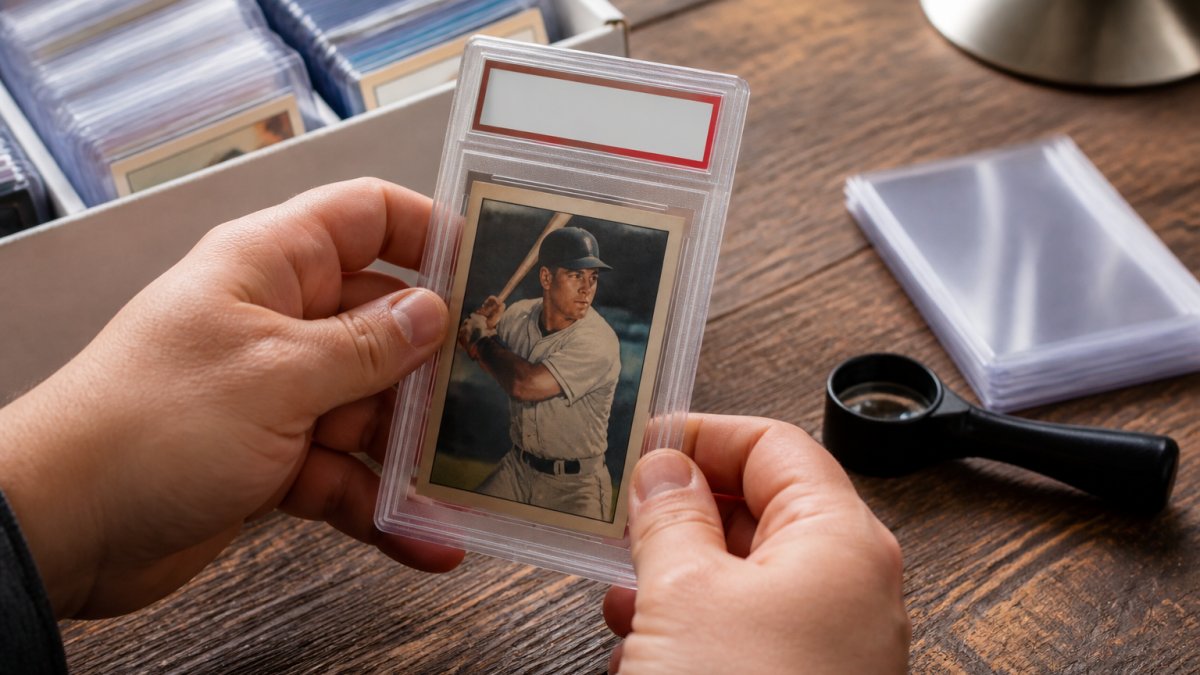
Trading card grading and investment are inseparable because condition drives price. A graded card in a slab with a documented grade is easier to value, sell, and verify.
What Grading Actually Does to a Card's Market
A grade converts an opinion into a comparable data point: once a card is encapsulated with a numeric grade, sold listings for that exact grade become your pricing benchmark. Without one, every raw sale is a one-off negotiation.
Three mechanisms matter more than the label on the slab:
- Population data. Grading companies publish how many examples of a card exist at each grade. A card with a large population at a high grade is common; a card with a tiny population at that grade is genuinely scarce. Population reports are the closest thing the hobby has to a supply ledger, and they change as more cards get submitted.
- Grade consistency. A raw card and a graded card are different markets. A card graded 9 and the same card graded 10 can trade at very different prices, so your comps must match the exact grade, not just the card.
- Slab integrity. A slab is only as trustworthy as the label and the holder. Buyers should verify the certification number against the grading company's public lookup, and should be wary of slabs with cracked holders, mismatched labels, or signs of tampering.
The Real Cost and Time of a Submission
Grading is a business expense, not a free upgrade. Tiers trade cost against turnaround: economy is cheaper per card but can take weeks to months, while expedited costs more and returns faster.
On top of the per-card fee, budget for:
- Shipping to the grader, insured and trackable, often the largest single line item on a small submission
- Return shipping and insurance, which the grader typically charges back
- Supplies, sleeves, card savers, and protective packaging that meet submission requirements
Experienced submitters batch cards so shipping and insurance spread across many, and reserve expedited tiers for cards where the expected grade jump justifies the premium.
When Grading Pays and When It Doesn't
The decision is arithmetic, not enthusiasm. Estimate the graded sale price from recent comps at the grade you realistically expect, subtract today's raw price, and compare that spread to your all-in grading cost. If it doesn't clear the cost with room to spare, sell raw.
Grading tends to pay when:
- The card is high-value enough that the grade premium is large in dollar terms
- The card is likely to grade high based on honest inspection
- The card is part of a set or player where graded examples are the norm
Grading tends not to pay when:
- The card's raw price is low relative to grading and shipping costs
- The card has visible flaws that cap the grade
- The market for that card trades primarily raw
Authentication and Condition Risk Beyond the Grade
Grading reduces condition risk but doesn't eliminate authenticity risk. Counterfeits, trimmed and recolored cards, and altered slabs all exist, and high-value purchases attract the most sophisticated fakes. Checks before you buy:
- Verify the certification number on the grading company's public lookup and confirm the card, grade, and label match
- Compare the slab's label typography and holder design against known examples from that grading company
- For raw cards, request close-up photos of corners, edges, and surface under angled light, and ask for a straight-on photo to judge centering
Treat grading as one tool in due diligence, not a substitute for it.
Trading Card Portfolio Diversification and Risk Management
Trading card portfolio diversification means spreading money across games, eras, and card types so one bad market doesn't sink you. Rare cards are volatile, and volatility is manageable only when no single position can hurt you badly.
Allocation Rules That Keep You Solvent
A simple allocation approach that keeps risk in check:
- Cap single cards at a small percentage of your total card budget
- Spread across at least three categories (different games, sports, or eras)
- Keep a cash reserve for genuine bargains instead of being fully invested
Diversification won't make you rich overnight, but it keeps a single misjudged purchase from ending the whole strategy.
The Due-Diligence Checklist Before You Buy Rare Cards
Before you buy rare cards, run the same checklist every time. Skipping steps is how counterfeits and overpriced purchases slip through.
- Confirm the exact set, year, variant, and grade
- Pull recent sold comps and calculate a trimmed average
- Check the population report for that grade
Fees, Taxes, Liquidity, and Your Real Net Return
Your real net return is what's left after fees, shipping, insurance, and taxes, and it's usually smaller than the headline number. Most card-investing content stops at "buy low, sell high"; this section turns a headline price into an actual return.
The Cost Stack on a Round Trip
Every card you buy and later sell passes through a stack of costs. Model them before you buy, not after you sell.
| Cost | When It Hits | What to Budget For |
|---|---|---|
| Buyer-side shipping and insurance | At purchase | Insured, trackable shipping on high-value cards; often a flat fee on marketplace orders |
| Sales tax | At purchase | Depends on your state and the marketplace's nexus; marketplaces increasingly collect and remit |
| Grading (if applicable) | Between buy and sell | Per-card tier fee plus shipping and insurance both ways |
| Marketplace selling fee | At sale | A percentage of the sale price, varying by platform and category |
| Payment processing | At sale | A percentage plus a fixed per-transaction amount on many platforms |
| Outbound shipping and insurance | At sale | Insured, signature-required shipping on high-value cards |
| Packaging and supplies | Throughout | Sleeves, card savers, top loaders, boxes, tape |
On a mid-value card, the round-trip cost stack eats a meaningful share of a modest gain; on a low-value card, fixed costs like shipping, payment processing, and supplies can exceed the entire profit.
A Simple Net-Return Model
You don't need a dozen spreadsheet tabs, just four numbers per card:
- All-in cost, purchase price plus buyer-side shipping, tax, and any grading you'll submit
- Expected sale price, the trimmed average of recent sold comps at the grade you'll sell, not the highest sale
- Exit costs, marketplace fee, payment processing, outbound shipping and insurance, and supplies
- Hold period, how long you expect to hold before selling
Net return = (expected sale price − exit costs − all-in cost) ÷ all-in cost. Annualize it by dividing by the hold period in years to compare against other investments.
Run this before every purchase. If the net return doesn't clear your hurdle rate after costs, the card isn't a good investment at that price, no matter how rare it is.
Taxes on Collectibles
Tax treatment of collectibles can differ from ordinary investments, and the rules depend on your situation. According to IRS guidance on collectibles and capital gains, collectibles can be taxed at a different rate than standard investments, so confirm your obligations with a qualified tax professional before you plan an exit. Two practical points most guides omit:
- Recordkeeping is the tax strategy. Track date acquired, all-in cost, date sold, sale price, and every fee. Without that record, you can't substantiate your basis, and you may overpay.
- Holding period matters. Long-term treatment generally requires holding for more than a year, so a card you plan to flip in three months is taxed differently from one you hold for three years. Build the hold period into your plan, not just your return math.
Liquidity: How Fast Can You Actually Sell?
Liquidity is the cost of getting out, and it varies enormously by card. Some sell in days at a tight spread to comps; others sit for months and only move at a discount. Before you buy, ask three questions:
- How deep is the buyer pool? A star rookie card in a popular sport or game has many potential buyers. An obscure parallel or a niche character may have a handful.
- How often does the card trade? A steady stream of sold comps means a real market. One sale in the last six months means you're the market.
- What discount clears it fast? If you needed cash in 30 days, what price would move it? That discount is a real cost of holding an illiquid card, even if you never pay it.
A card with no buyers isn't an asset, it's a hostage. The less liquid the card, the smaller the position, because you can't count on exiting on your schedule.
Exit Planning Before You Enter
Decide your exit before you buy, in writing:
- Target sale price based on comps, not hope
- Target hold period and the tax implications of short versus long term
- Exit venue, marketplace, auction house, dealer, or private sale, and the fee structure of each
Investors who plan exits tend to outperform those who plan only entries, because the exit plan forces honest cost and liquidity assumptions at purchase, when you can still walk away.
Conclusion
The hardest part of card investing isn't finding rare cards. It's staying disciplined when a hyped set tempts you to break your own rules.
At Dave's House of Cards, we make it easier to build a collection with individual cards from popular series, convenient online shopping, and free standard shipping on orders over $7.50.
Frequently Asked Questions
Is it a good idea to invest in Pokemon cards?
Pokemon cards can work as an alternative investment, but only for the right cards. Sealed vintage product, high-grade rookie-era holos, and low-population graded cards have the clearest track record. Modern bulk and reprints rarely appreciate. Treat Pokemon as one slice of a diversified portfolio, not a core holding, and budget for grading fees, selling fees, and the time it takes to find a buyer. Buy the card you can resell, not the one you hope will moon.
How can you tell whether a rare trading card is a good investment?
Start with comparable sales, not asking prices. Pull the last 10 to 20 sold listings for the exact card in the same grade, drop the outliers, and use the median as your entry price. Then check the population report for that grade, the print run, and whether the character or player still has demand. If the spread between buy and sell is wide, or the card only sells once a month, the liquidity risk usually outweighs the upside.
Does professional grading increase a card's value?
Often yes, but not always enough to justify the cost. Grading helps most when a card is likely to score a 9 or 10 and the population at that grade is low. On mid-grade vintage or modern cards with huge populations, the grading fee can eat the premium. Run the math before submitting: compare raw sold prices to graded sold prices at the grade you expect, subtract the fee and shipping both ways, and only submit when the gap is clearly positive.
What risks should you consider before buying cards as investments?
The big ones are counterfeits, condition risk, liquidity, and concentration. Counterfeits are common on high-value vintage and popular modern chase cards, so buy from sellers with clear authentication and a return window. Condition risk means a card can arrive with hidden surface or corner issues that cost you a grade. Liquidity risk means you may wait weeks or months to sell. Concentration risk means one bad buy can wipe out several good ones, so cap any single card at a small share of your card budget.