 how-to
How to Complete Trading Card Sets Without Overspending
Last Updated: October 28, 2026
Quick Summary
To complete trading card sets without overspending, first define your goal, such as a base set or master set, and write a budget for the whole project. Then build a checklist to track owned, needed, and duplicate cards, buy bulk lots, trade duplicates, and buy singles only for remaining gaps.
- Decide the exact set and completion level, base set or master set, before buying anything.
- Build a checklist with one row per card number, including owned status, condition, and estimated cost.
- Sort your cards into keepers, duplicates, and off-set cards before buying anything new.
- Store duplicates in a separate For Trade box so you never trade away a card you still need.
- Buy key and high-value cards last, and only when your budget allows.
Table of Contents
- Choose Your Set Goal and Define Completion
- Build a Trading Card Set Checklist to Track Progress
- Inventory What You Own and Sort Out the Duplicates
- Organize Your Cards So You Can Find Them Fast
- Start With Bulk Lots and Prioritize Key Cards
- Buy Individual Trading Cards to Fill the Gaps
- Trade Duplicates, Budget Your Spending, and Finish Your Set
- Frequently Asked Questions
Choose Your Set Goal and Define Completion
Finishing a trading card set is one of the most satisfying parts of the hobby, but it is also one of the easiest ways to spend far more than you planned. This guide can help you finish complete trading card sets with a clear plan, so every purchase moves you closer to done.
The first step is deciding what "done" means for you. Many collectors start with a vague goal like "I want the whole set," then keep buying without ever knowing how close they are. A clear goal fixes that problem.
Before you buy anything, write down three things:
- The exact set you are building (name, year, and release)
- Your completion level (base set only, full set, or master set)
- Your budget for the whole project, not just the next pack
Base sets, master sets, and what counts as complete
A base set usually includes the standard cards printed in one release. A master set is larger. It can include every variant, reverse holo, promo, or alternate printing tied to that release.
Complete trading card sets can mean different things, so check the checklist for the product you are working from. A base set is often much cheaper to finish than a master set. Decide which one you actually want before you start spending. Excess cards accumulated during this process should be managed strategically to recover inventory value as you refine your collection goals.
Build a Trading Card Set Checklist to Track Progress
A trading card set checklist can help you track what you own and what you still need. You can also record the cost of each missing card.
A spreadsheet lets you sort, filter, and total costs. You can also use a paper list.
The columns that actually matter
Build one row per card number and include these columns:
- Card number (the number printed on the card, not the player name)
- Card name and subset (base, insert, parallel, promo)
- Variant (base, reverse holo, foil, alternate art)
- Owned (Yes/No, or a quantity if you keep duplicates)
- Condition (use a consistent scale such as Near Mint, Lightly Played, Moderately Played, Heavily Played, Damaged)
- Estimated cost (the current single-card price you would pay)
- Acquisition status (Need, Ordered, In Transit, Received)
- Source (where you bought or traded for it)
- Notes (seller, trade partner, date)
You can add a priority column, High, Medium, Low, to sort by what to chase next.
A simple build order
- Open the official checklist for your release and copy every card number into the first column. Do not skip promos or variants if you are building a master set.
- Add the columns above as headers.
- Mark every card you already own as Owned = Yes and fill in condition.
- Sort by Owned so all the gaps rise to the top.
- Add estimated costs for the gaps, then total the column. That total is your realistic remaining spend, not the price of the next pack.
Use the checklist as a buying gate
Before every purchase, open the sheet and confirm the card is marked Need. After every trade or order, update the row. If you let the sheet go stale, you may buy duplicates you already own.
The checklist can help you notice which subsets are still missing and track estimated costs against your budget.
A checklist can help turn a vague goal into a repeatable process. Once the sheet is built, you can track how close you are to finishing the set.
Inventory What You Own and Sort Out the Duplicates
Before you buy a single card, count what you already have.
Sort your cards into three piles:
- Keepers that fill a gap on your checklist
- Duplicates you can trade or sell
- Off-set cards that do not belong to your target set
Duplicates are valuable. Each extra copy of a card you need is a trade chip. Put them in a separate box so you can use them to get missing cards without spending cash.
A common mistake is buying cards you already own because you forgot about them. Checking your inventory first prevents this.
Organize Your Cards So You Can Find Them Fast
Good organization can help you keep track of cards you already have.
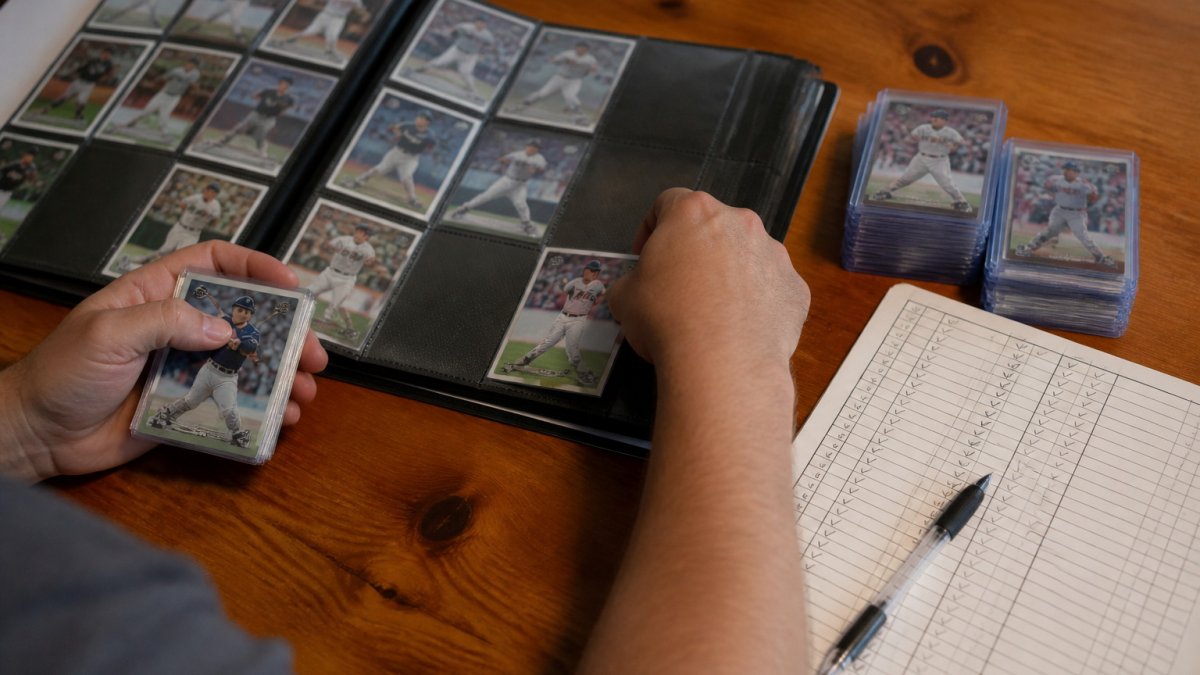
Use these basics:
- Store cards in sleeves to protect condition
- Keep sets together in binders or boxes, sorted by card number
- Label every box or binder with the set name
- Keep your checklist next to your storage
Sorting by card number works best for set building. Sorting by type or rarity can help if you trade often. Pick one system and stick to it.
Start With Bulk Lots and Prioritize Key Cards
Bulk lots can be one way to fill a set.
Once you have a bulk lot, focus on the hard cards:
- Key cards are the rare or popular cards that anchor a set
- Star cards are high-demand cards that players and collectors chase
- High-value cards cost more, so buy them last and only when your budget allows
You can buy common cards in bulk and go after other cards one at a time.
Buy Individual Trading Cards to Fill the Gaps
After bulk lots and trades, you may still have missing cards. Single-card buying is another option.
You can use your checklist to identify the cards you still need. Compare each card's price with what you have already spent to track your spending.
When you shop, check the card's condition and read the seller's description closely.
Dave's House of Cards offers individual trading cards from popular series, which can help you fill specific gaps. Shipping offers include free Standard Shipping over $7.50 and free USPS Ground Advantage Shipping over $25. Check the site for current prices and availability before you order.
Trade Duplicates, Budget Your Spending, and Finish Your Set
Trading is one way to work toward finishing a set. Organizing duplicates can help you keep track of them.
Turn duplicates into a trade inventory
Pull every duplicate out of your binders and boxes and log it in the Duplicates tab of your checklist. Tips for spotting valuable vintage cards can help you spot which duplicates are worth more than they look. For each copy, record:
- Card number, name, and variant
- Condition (use the same scale as your main checklist)
- Quantity
- Estimated single-card value
Sort duplicates by set and card number so you can pull a trade list in minutes. Keep them in a separate box or binder labeled For Trade so you never accidentally trade a card you still need.
Value cards before you offer
Use recent sold listings on major marketplaces as your reference, not asking prices. You can use recent sold prices for cards in the same condition as one reference when valuing both sides of a trade.
- Compare like condition to like condition. A Near Mint card is not a fair swap for a Heavily Played copy.
- Account for shipping. If you are mailing cards, each side pays their own postage unless you agree otherwise in writing before the trade.
- Bundle commons. You can offer commons you do not need in a trade for a card you do need.
Trade etiquette that keeps partners coming back
- Confirm condition with photos before agreeing.
- State exactly what you are sending and what you expect in return.
- Use protective packaging when shipping cards.
- Use tracked shipping for anything of meaningful value, and share the tracking number.
- You can leave feedback or a thank-you after the trade.
Budget the whole project, not the next pack
Set a hard total budget and divide it across the stages in this guide. You can divide your budget across the stages in this guide:
- Bulk and commons: a share of your budget
- Key and high-value cards: a share of your budget
- Singles to close gaps: a share of your budget
- Shipping and supplies: sleeves, top loaders, and mailers are real costs, budget for them
Track actual spending against your budget in your checklist. If you reach your limit, you can sort by Need.
Finishing a set takes patience. You can track every card, keep a duplicate inventory, trade fairly, and use your checklist to identify what you still need.
The table below summarises how to split your budget across the stages of the project.
| Stage | Spending approach | Note |
|---|---|---|
| Bulk and commons | A share of your budget | Fills many slots cheaply |
| Key and high-value cards | A share of your budget | Buy last, when budget allows |
| Singles to close gaps | A share of your budget | Use your checklist to target needs |
| Shipping and supplies | Budget for it | Sleeves, top loaders and mailers are real costs |
Frequently Asked Questions
How do you complete a trading card set?
Start by choosing a clear completion goal, such as a base set or a master set with all variants. Then make a checklist of every card number, inventory what you already own, and mark your gaps. You can work on filling the gaps by opening bulk lots, trading duplicates with other collectors, or buying individual cards. A checklist can help you track your progress.
What is the difference between a complete set and a master set?
A complete set usually means you own one copy of every card in the base set, as numbered in the checklist. A master set is broader and typically includes every variant, such as reverse holos, alternate art, or special printings, in addition to the base cards. Master sets cost considerably more to finish. Before you start, decide which definition you are working toward so you do not chase variants you never intended to collect.
Is it better to buy individual cards or open packs to complete a set?
Buying individual cards lets you select cards you know are missing. Opening packs is random, so you may pull duplicates. You can choose an approach based on whether you prefer selecting specific cards or opening packs.
Where can I buy individual trading cards to finish a set?
You can buy individual cards from online card shops, local game stores, trade events, and collector communities. Dave's House of Cards offers a curated selection of individual cards from popular series. Check the site for current prices and availability.