 ultimate-guide
Near Mint Card Quality Standards Explained
Table of Contents
- What Is Near Mint Condition for Trading Cards
- Near Mint vs. Mint vs. Lightly Played: Key Differences
- The Four Critical Inspection Points for Near Mint Cards
- How to Grade Trading Cards at Home
- Trading Card Grading Tools and Equipment
- Manufacturing Defects vs. Play Wear: What Counts Against Near Mint
- Professional Grading vs. Raw Card Condition Assessment
- Common Mistakes When Evaluating Near Mint Condition
- Frequently Asked Questions
Last Updated: October 4, 2026
What Is Near Mint Condition for Trading Cards
Near mint card quality represents one of the highest grades in the trading card collecting world, sitting just below the perfect Mint standard.
The definition of near mint card quality varies slightly across different grading standards, but the core principle remains consistent: the card must demonstrate excellent preservation with only the faintest traces of handling or minor manufacturing imperfections.
The Near Mint Definition Across Grading Standards
Professional grading organizations have established benchmarks for what qualifies as near mint: sharp corners with minimal rounding, excellent print quality, centering within acceptable ranges, nearly complete surface gloss with only light micro-scratches visible under magnification, and a clean back with no significant wear.
Different grading companies use slightly different terminology, "Near Mint," "NM," or "NM-MT", but they evaluate the same fundamental characteristics, helping collectors and investors make informed purchasing decisions.
Why Near Mint Matters to Collectors and Investors
Near mint condition cards hold their value significantly better than lower grades because they're rare.
Investors value near mint cards because they occupy a practical middle ground: a Mint card might cost five times more but won't necessarily appreciate faster, while near mint cards offer better liquidity and more potential buyers.
Near Mint vs. Mint vs. Lightly Played: Key Differences
Understanding how near mint card quality compares to adjacent grades helps you make smarter purchasing decisions. The differences between these grades involve subtle but important distinctions in wear patterns, surface condition, and overall preservation.
Mint Condition: The Highest Standard
Mint cards represent perfection or near-perfection in the original packaging. These cards show no visible wear to the naked eye, with flawless corners, perfect centering, and unblemished surfaces.
Mint cards are exceptionally rare, especially for vintage releases. The price premium for Mint versus near mint can be substantial, sometimes 300-500% higher, because true Mint examples are so scarce.
Lightly Played: First Signs of Wear
Lightly played cards show the first visible evidence of handling: minor corner rounding, noticeable edge whitening, reduced surface gloss, light scratches visible to the naked eye, and slightly off-center alignment.
A near mint card shows wear indicators only under magnification, while a lightly played card displays them readily. Lightly played cards typically sell for 40-60% of near mint prices for the same card.
Moderately Played and Heavily Played Conditions
Moderately played cards show obvious wear: rounded corners, significant edge whitening, visible surface scratches, and noticeable centering issues.
Heavily played cards show severe corner rounding, heavy edge whitening, multiple visible scratches, and poor centering, with prices typically 10-20% of near mint value or less.
The Four Critical Inspection Points for Near Mint Cards
Evaluating near mint card quality requires systematic inspection of four key areas. Each contributes equally to the overall assessment, and a card can only qualify as near mint if all four areas meet the standard.
Centering: Measuring Image Placement
Centering refers to how evenly the card's image is positioned within the borders. Near mint cards should show centering within approximately 50/50 to 60/40 ratio, with borders nearly equal or only slightly off.
To assess centering, hold the card at eye level and examine the white borders on all four sides.
Surface Wear and Gloss Retention
Near mint cards retain nearly complete gloss, with only light micro-scratches visible under magnification. These hairline-thin scratches don't affect the card's appearance without magnification.
Examine the surface under bright light and magnification for scratches, scuff marks, and gloss loss. Both front and back should show excellent gloss retention.
Edge Whitening and Corner Sharpness
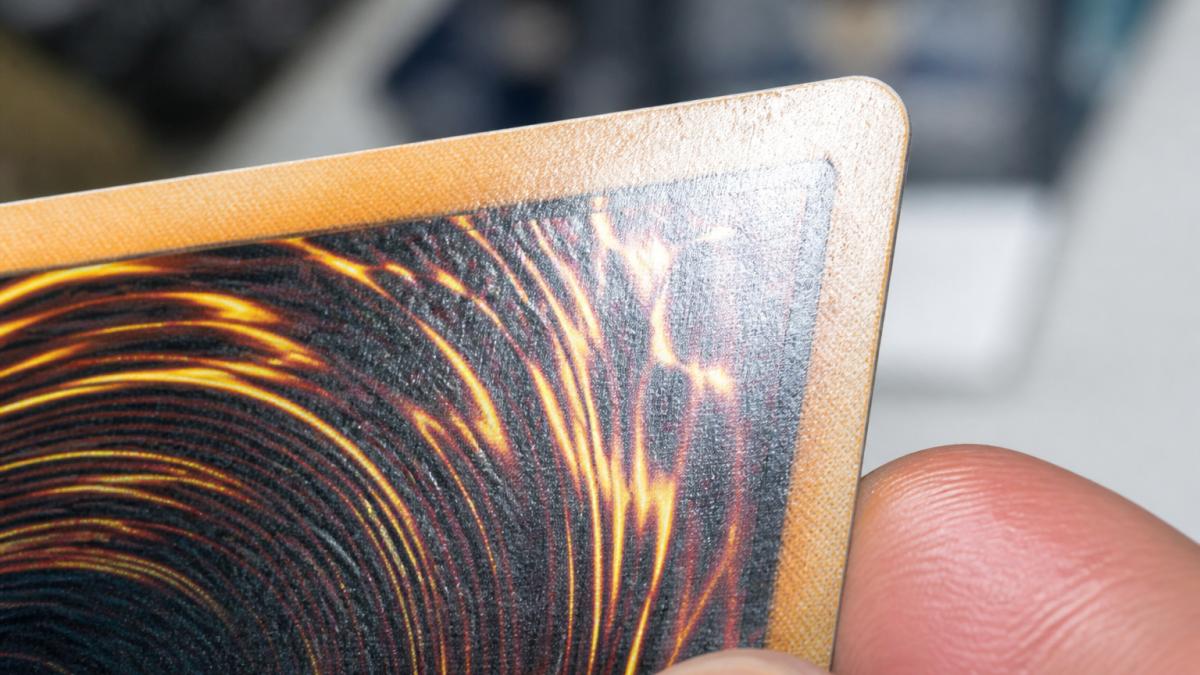
Edge whitening occurs when the card's edges are bent, revealing white cardstock beneath.
Inspect all four corners and edges carefully. Run your finger lightly along the edges; they should feel crisp without rough spots. Corner sharpness is one of the most visible indicators of handling wear.
Back of Card and Print Quality Issues
The back of the card often shows wear patterns differently than the front.
Examine the back under magnification for scratches, stains, or print defects. Manufacturing defects like print lines, slight color variations, or minor alignment issues are acceptable if they came from the factory.
How to Grade Trading Cards at Home
Grading cards at home requires the right tools and a systematic approach. While professional graders use decades of experience and standardized lighting, you can achieve reliable assessments with proper equipment and methodology.
Step 1: Set Up Proper Lighting and Magnification
Create a dedicated inspection station with bright, full-spectrum lighting. A desk lamp with daylight-temperature bulbs works well. A 10x jeweler's loupe or USB digital microscope reveals surface details invisible to the naked eye.
Step 2: Examine Centering and Print Lines
Start by assessing centering with the naked eye, then examine under magnification for print lines. Near mint cards show minimal print lines consistent with factory standards.
Step 3: Check for Surface Scratches and Micro-Scratches
Under magnification, scan the entire front surface for scratches and hairline marks. Near mint cards show only light micro-scratches with no visible scratches to the naked eye.
Step 4: Assess Corners, Edges, and Handling Wear
Examine each corner individually under magnification for rounding, chipping, or wear. The edges should remain sharp with minimal whitening and feel crisp to the touch.
Check all four corners and all four edges. A single heavily worn corner can disqualify a card from near mint status.
Step 5: Document Your Findings
Record your observations for each inspection point. Note the centering ratio, any visible scratches or micro-scratches, corner condition, edge whitening, and any manufacturing defects. This documentation helps you make consistent assessments and provides a reference if you revisit the card later.
| Inspection Point | Near Mint Standard | What to Document |
|---|---|---|
| Centering | 50/50 to 60/40 ratio | Border measurements, balance assessment |
| Surface Gloss | Nearly complete, light micro-scratches only | Scratch visibility, gloss retention level |
| Corners | Sharp with minimal rounding | Rounding degree, any chipping |
| Edges | Minimal whitening, crisp feel | Whitening extent, edge sharpness |
| Back of Card | Clean, minimal wear, good print quality | Scratches, stains, print line visibility |
Trading Card Grading Tools and Equipment
Proper tools make home grading more reliable and consistent. The right equipment helps you see what professional graders see when they evaluate near mint card quality.
Magnification Tools for Detailed Inspection
A 10x jeweler's loupe is the standard tool for card inspection, offering sufficient magnification to reveal micro-scratches and fine print details. Loupes are affordable and portable.
USB digital microscopes offer higher magnification (40x to 200x) and allow you to photograph findings for documentation, though they cost more than loupes.
Lighting Solutions for Accurate Assessment
A desk lamp with full-spectrum daylight bulbs (5000-6500K color temperature) provides consistent, neutral lighting that reveals true card condition. Position the light at an angle to highlight surface wear.
Centering Guides and Measurement Aids
A centering guide is a transparent overlay that helps you measure border ratios quickly and assess whether borders fall within the near mint range.
Manufacturing Defects vs. Play Wear: What Counts Against Near Mint
Distinguishing between factory defects and handling damage is crucial for accurate near mint assessment. The same visual imperfection might be acceptable or disqualifying depending on its origin.
Manufacturing defects occur during production and include print lines, slight centering issues, color variations, and minor surface irregularities.
Play wear results from handling, storage, or use: edge whitening from bending, corner rounding from shuffling, and surface scratches from contact.
Factory Defects That Disqualify Near Mint Status
Some manufacturing defects prevent near mint classification: heavy print lines covering significant portions, major centering issues beyond acceptable range, and obvious color printing errors.
Play Wear Indicators and Subjective Assessment
Play wear is subjective because it exists on a spectrum. Light handling wear requiring magnification might be acceptable for near mint, while obvious wear visible to the naked eye is not.
Surface scratches visible without magnification, obvious corner rounding, and noticeable edge whitening all indicate play wear beyond the near mint standard.
Professional Grading vs. Raw Card Condition Assessment
Professional graders evaluate cards using standardized criteria and decades of experience.
Professional graders use consistent lighting, magnification, and reference standards across every card. Their assessments carry market weight because buyers trust the evaluation.
Raw card assessment requires applying the same standards without professional experience. Grade conservatively, it's better to underestimate condition than overestimate.
How Professional Graders Evaluate Near Mint Cards
Professional graders follow a standardized protocol: examine centering, surface condition, corners, and edges under consistent magnification and lighting, compare against reference standards, and note any defects before determining the grade.
Raw Card Assessment and Marketplace Standards
When buying raw cards from individual sellers, marketplace standards are less consistent than professional grading, creating both risk and opportunity.
Developing reliable assessment skills gives you an advantage in the raw card market, helping you find better values and make smarter purchasing decisions.
Common Mistakes When Evaluating Near Mint Condition
Collectors frequently make predictable errors when assessing near mint card quality.
One common mistake is overweighting a single aspect of condition.
Another mistake is underestimating magnification's importance.
Collectors sometimes confuse manufacturing defects with play wear.
Inconsistent lighting during assessment can lead to different conclusions about the same card.
Finding near mint cards that meet your standards requires knowing exactly what to look for.
Frequently Asked Questions
What does LP mean in the context of card condition?
LP stands for Lightly Played. It describes cards that show minor signs of handling wear, such as light surface scratches, slight edge wear, or minimal gloss loss, but remain in good overall condition. Lightly played cards are noticeably below near mint but still acceptable for most collectors and players who prioritize playability over pristine appearance.
What is the difference between near mint and lightly played cards?
Near mint cards have minimal wear with sharp corners, perfect centering, and intact gloss. Lightly played cards show visible handling wear including light scratches, minor edge whitening, and slight gloss loss. The key difference: near mint looks almost untouched, while lightly played shows evidence of actual use but remains well-preserved overall.
What defects disqualify a card from being near mint?
Cards are disqualified from near mint status if they have creases, heavy surface scratches, significant edge whitening, off-center printing, wax staining, indentations, or noticeable gloss loss. Even minor manufacturing defects like print lines or uneven card stock can lower a card below near mint. Any visible handling wear beyond light micro-scratches typically removes near mint status.
How should I grade vintage Pokémon cards at home?
Use magnification and bright lighting to examine centering, surface gloss, corner sharpness, and edge wear. Check both front and back for scratches, print lines, and discoloration. Compare your findings to professional grading standards. Document your assessment with photos. Note that older cards may have manufacturing quirks that differ from modern cards, so research the specific set's typical characteristics before grading.
Is PSA 7 considered near mint?
PSA 7 is classified as Near Mint/Mint by PSA grading standards, but it sits at the lower boundary of that range. PSA 7 cards show slight wear visible under close inspection but maintain strong overall appeal. PSA 8 and higher represent cleaner near mint examples. For competitive play or investment, many collectors prefer PSA 8 or above for true near mint quality.
How do professional grading standards differ from raw card assessment?
Professional graders use standardized criteria, magnification tools, and consistent lighting to assign numeric grades. Raw card assessment relies on personal judgment and may vary between sellers. Professional grades provide third-party verification and are widely accepted in marketplace transactions. Raw cards depend on seller descriptions, which can be subjective. Professional grading costs extra but adds credibility and resale value.